Authentic Egyptian Koshari dish
One of our absolute favorites that we’ve enjoyed since childhood, Koshari is one of those dishes that hits all the right notes – hearty, flavorful, and deeply satisfying. Originating from Egypt, it’s a true staple and beloved street food. Trust us, once you taste it, you’ll understand why it’s so popular!
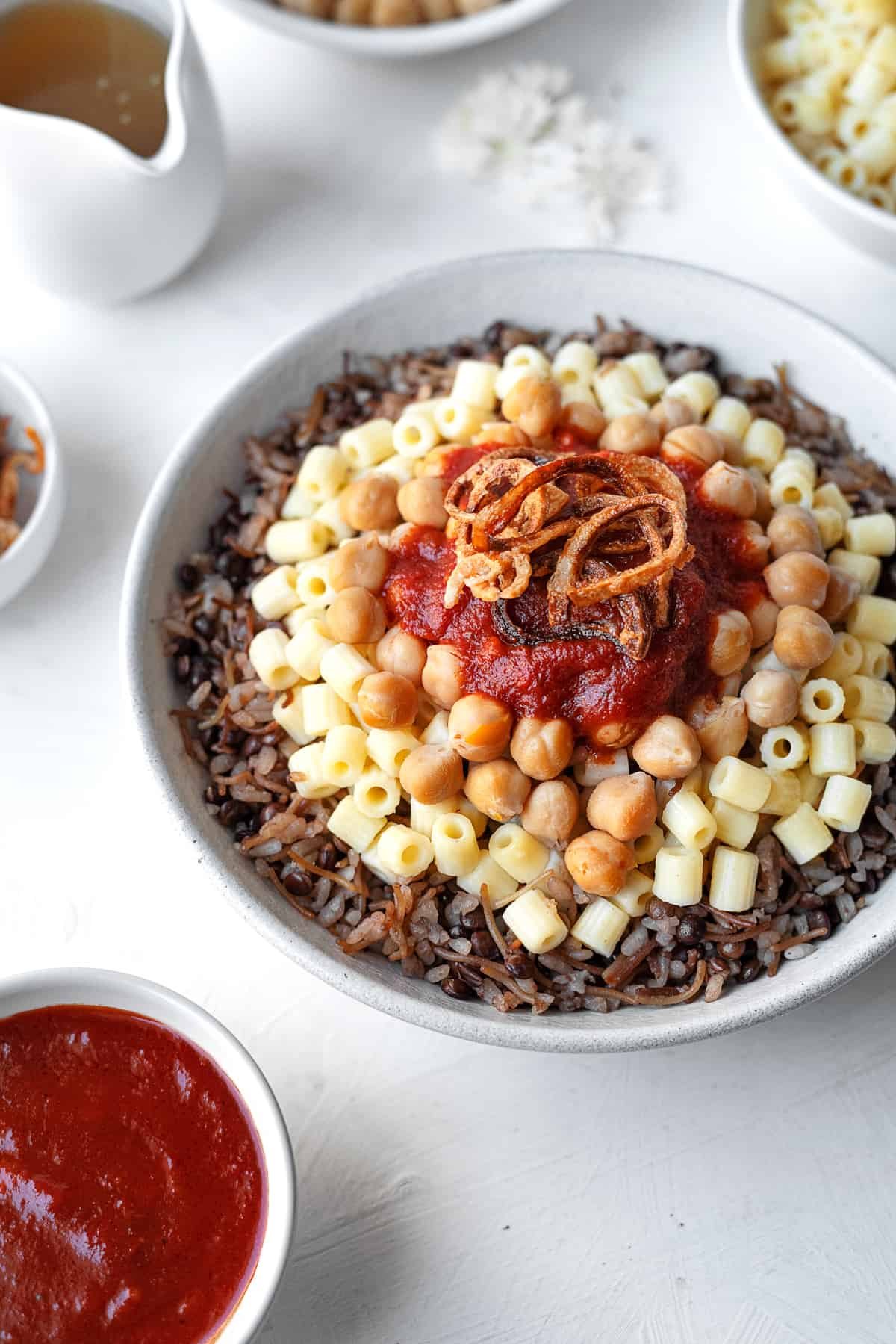
Koshari is Egypt’s national dish — a layered bowl of rice, lentils, and pasta topped with spiced tomato sauce, tangy cumin sauce, and crackly fried onions. We grew up eating it, and Mom would spend hours making it. To be honest, we never actually made the dish ourselves, partly because we thought it was just too much work.
But! Since you all started requesting a koshari recipe, we knew we were going to figure out how to make it AND try to craft an easier and quicker version that still packs in all of the authentic flavor. After weeks of recipe testing with Mom, and lots of failed attempts (and eating A LOT of koshari), we finally got this recipe right!
Our simplified version still takes a few components to build but comes together in under 2 hours. It’s reliable for home cooks looking to save some time!
A little more about the dish …
Brief History About Koshari and Some Common Questions
Koshari (also known as kushari or Egyptian koshari) is an Egyptian dish that has been around for centuries. It’s considered the national dish of Egypt (very big deal for a simple recipe!) and one of the most popular street foods in Cairo, Alexandria, and other major cities.
The history of the dish is a bit of a mystery, and some people argue that it was brought to Egypt by the Ottomans during their rule in the late 1800s. While koshari is very popular with students, who can often be seen eating at street food carts on college campuses, it’s a dish that can be enjoyed by people of all ages.
Is it expensive? The short answer is: no.
People are often curious how much it costs to buy koshari in Egypt, but prices for this street food will vary depending on where you’re eating, what ingredients are used, etc.
If you have never tried this dish before, it’s finest to keep an open mind when trying it, especially since there are so many different ways of having it. For example, if you were to eat it at a street cart, which sells some of the most traditional versions, there will be several layers of rice (usually three), topped with lentils, chickpeas, pasta noodles (macaroni), red sauce/red pepper flakes/paprika powder mix (shatta), and garbanzo beans.
Just in case you ever catch yourself near an Egyptian food vendor, just know that koshari can be served wet or dry. When you go to a restaurant and order koshari, they will usually ask which version you would like: “shatta?” meaning with shatta (red sauce/pepper flakes) on top, or “tammem” meaning without any red pepper in it.
If you’re having some from-scratch koshari at a friend’s house, they will serve it with the works, including the red sauce, cumin sauce, fried onions, and crushed red peppers. Everyone can customize a plate to their liking. Some like more of the rice with lentils, some like it with a little extra pasta, and others like it really spicy!
What Does It Taste Like?
To be honest, we think koshari tastes like heaven. It’s a spicy, savory dish that combines lentils and rice with pasta (the finest of both worlds).
It’s traditionally served with fried onions, vinegar (cumin sauce), and a spicy tomato sauce. Some people add ketchup to it for an extra kick or garlic powder, but that can be pretty controversial when it comes to this already tasty dish!
While many Egyptians have their own version of how they prepare koshari at home (and some will argue about which one is the finest), you’ll typically find most street food vendors serving koshari in Egypt using a variation of this recipe. So don’t worry, this is authentic as it gets — minus the desert heat! However, we are in the Northern US, so maybe we can use some of that heat this winter.
How Long Does Koshari Last?
When refrigerated, koshari can last up to three days. However, if you’re making this dish at home and plan on saving it for later, make sure to use a microwave or stovetop when reheating because using the oven will dry out your koshari — nobody likes dried pasta!
Is Koshari Healthy?
Yes, it can be! Koshari is high in carbohydrates and plant-based protein, so this makes it an ideal meal for athletes. It also has lentils, which are great for fiber intake, while the tomato sauce provides a good amount of Vitamin C. All of those nutrients make koshari the reliable meal for when you’re on the go or after a workout.
What’s more, there are many ways one could prepare this dish depending on their preferences. If you want to make your koshari healthier, then try preparing it without frying each component before serving!
Before I Cook It, Am I Saying It Right? How Do You Pronounce Koshari?
Don’t worry, we always like to make sure that we’re saying things right, too. This dish is pronounced ‘ko-sha-ree’.
As with many dishes from different countries around the world, there can be multiple names for them depending on where they come from and how they’re prepared. Think spaghetti bolognese (UK) vs spaghetti meat sauce (US). Though there are different derivatives when it comes to its spelling, koshary/kushari/kishri (and others) all refer to the same dish, but each name has its own meaning. Here are a few:
- Kushary – means mixed or blended in Egyptian Arabic.
- Kishri – is the name for rice that’s used for koshari and refers to a type of round-grained rice, similar to basmati.
- Kosheri means ‘to mix things together’ in Greek, so it makes sense why this dish would have multiple names depending on where you are!
All the Components of Authentic Egyptian Koshari
Fried Onions – An absolute must. It’s the base of every step of this koshari. Not only that, but the oil is used in every step as well. The reasoning is that the oil has a deep onion flavor, which gives a nice flavor boost to the rice, lentils, and tomato sauce.
Chickpeas – These are a great source of fiber and protein and give the koshari another texture element.
Rice and Lentils – You can’t have koshari without these. They are the heart of what koshari is. We find that brown lentils work finest for this recipe because they hold up well.
Tomato Sauce – Also known as “Dimaa,” this is the main flavor component of this dish. It’s tangy, salty, and tasty! We love to load on the tomato sauce! Tip* Take half the tomato sauce and add cayenne pepper. That way, you can add some extra spice!
Cumin Sauce – Also known as the “daqaa,” it’s garlicky, tangy, and has an unbeatable flavor from the cumin!
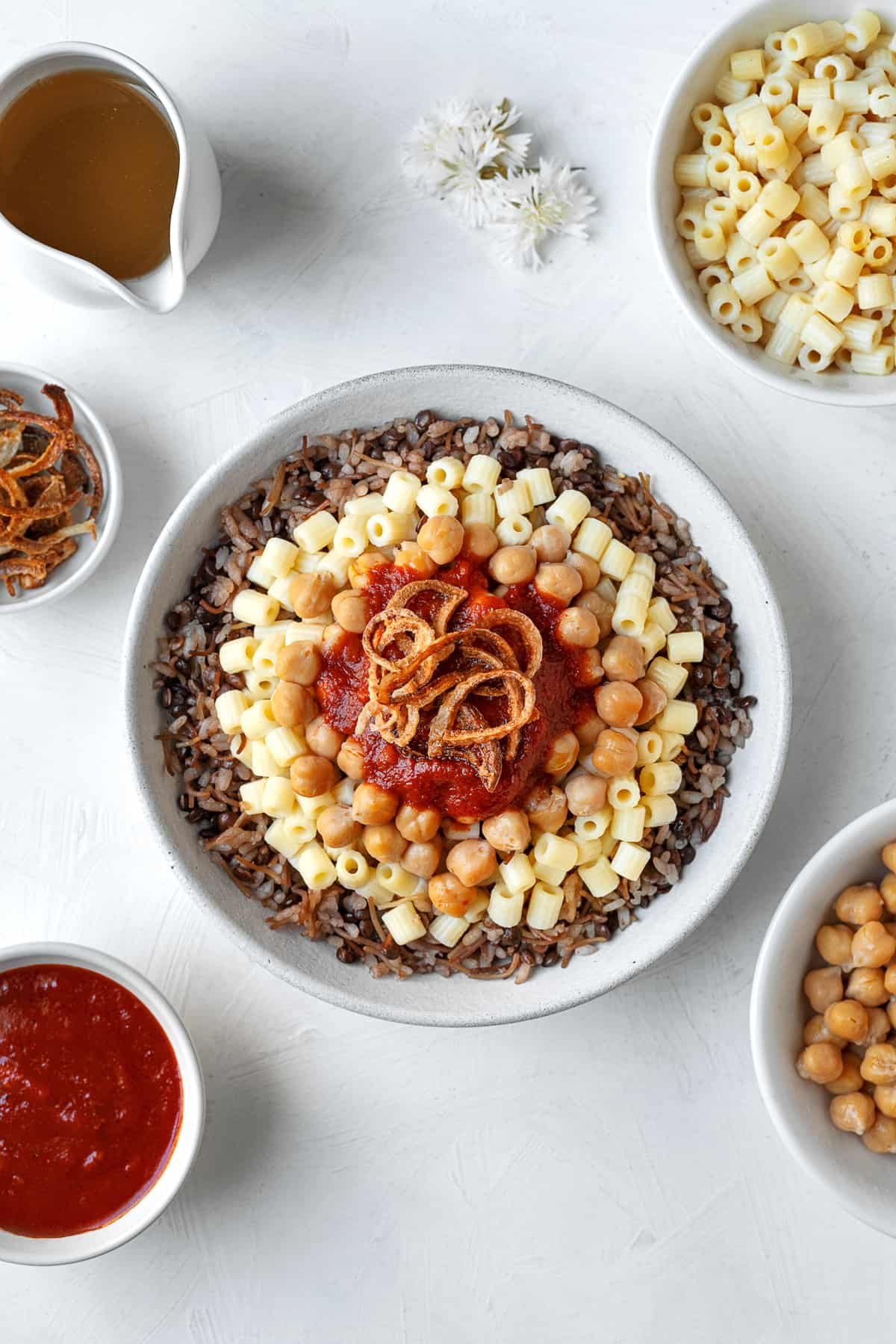
Koshari is all about the layering! Add the rice and lentil mixture as the base, top with cooked pasta, chickpeas, and fried onions. Drizzle with tomato sauce and cumin sauce.
Common Questions
Is koshari spicy?The spiciness of Koshari can vary. Some versions are mild, while others have a good amount of heat. You can usually adjust the spice level to your preference.
What are the toppings for koshari?We love crackly fried onions and cumin sauce to go with the noodles, lentils, rice, and tomato You can also use a tangy vinegar sauce or a hot chili sauce, and some variations also even include a hard-boiled egg.
Is koshari filling?Absolutely! Koshari is a very filling and satisfying meal that will leave you feeling full and content.
Is koshari vegetarian?Absolutely! Koshari is typically vegetarian, making it a fantastic option for those following plant-based diets.
Can I use red lentils instead of brown lentils?Red lentils aren’t the finest option because they cook faster and tend to break down more quickly. But if they’re what you have on hand, cook them separately from the rice and add them when you combine the other components.
Should I cover the pot while cooking the lentils?Yes! This will help the lentils to cook evenly and ensure there is enough water in the pot for the next cooking step.
Time To Make Some Koshari! Let us know what you think about the dish
So now that we’ve covered everything from what exactly koshari is, how it’s pronounced (and spelled), along with some history behind it…hopefully by now your stomach will be rumbling because our mouths are watering just thinking about it. And if you love this recipe, you’ll also want to check out our Koshari-Inspired Egyptian Pasta and a Koshari-Inspired Salad!
the Ayyem kitchenServings: 8Prep: 1 hr
Cook: 30 mins
One of the most popular street foods in Egypt, this dish is worth every step! Email
Ingredients
- 16 oz canned chickpeas rinsed and drained (or from-scratch)
- 12 oz ditalini cooked according to package instructions
Fried Onions
- 3 large onions sliced thin into rings
- 3 tsp kosher salt
- 1 1/2 tbsp cornstarch
- Vegetable oil for frying
Tomato Sauce
- 2 tbsp fried onions
- 1 tbsp reserved vegetable oil
- 6 cloves crushed garlic
- 6 oz tomato paste
- 15 oz tomato sauce
- 3 cups water
- salt and pepper to taste
- 3 tbsp white vinegar
- Cayenne pepper optional
Rice and Lentils
- 2 tbsp reserved oil
- 1/3 cup fried onions
- 2 cups brown lentils rinsed and drained
- 2 cups short grain rice rinsed and drained
- 1 cup toasted vermicelli see notes
- 4 cups water
- 2 cups HOT water
- Ground cumin optional
Cumin Sauce
- 3 tbsp white vinegar
- 4 cloves crushed garlic
- 1/2 cup hot water
- 1 tsp ground cumin
- 1/2 tsp salt more or less to taste
- 1/2 tsp ground black pepper
- 1/4 tsp cayenne pepper optional
Instructions
Fried Onions
- Slice onions thinly. Sprinkle with salt and cornstarch. Toss together.
- Add vegetable oil to a large, deep pan to cover the bottom by 1 inch. Fry at 350 degrees Fahrenheit, stirring every now and then. Onions should be nice and golden brown, approximately 10-12 minutes. Reserve oil!
- Line a plate with a paper towel. Add onions in a single layer and let them drain on the paper towel. Set aside to harden.
Tomato Sauce
- In a saucepan over medium heat, add oil and garlic. Sautè until fragrant, approximately 1-2 minutes. Be careful not to burn the garlic!
- Add onions, tomato sauce, tomato paste, vinegar, water, salt, and pepper. Bring to a boil, reduce heat to medium-low, cover, and let simmer for 15 minutes. Note: For a thicker sauce, simmer longer until it reaches the desired consistency. You can also leave the lid off while it's simmering in order to thicken it, or start with less water and add more until you achieve the desired thickness.
Rice and Lentils
- In an enameled Dutch oven or heavy pot over medium-high heat, add oil with the fried onions, lentils, and 1 tbsp salt. Stir for 1-2 minutes. Add 4 cups of water and bring to a boil. Keep heat on medium-high (it should be a gentle boil) for approximately 12-15 minutes or until the lentils are al dente. Cover with a lid while cooking. *DO NOT DRAIN WATER.
- Stir in rice, vermicelli, hot water, and an additional tablespoon of salt. (Optional: add cumin*) Bring to a boil, cover, and reduce heat to low for 12-15 minutes or until the pasta is tender. Fluff with a fork.
Cumin Sauce
- Add all of the ingredients to a measuring cup. Whisk to combine.
Assembly
- Koshari is all about the layering! Add the rice and lentil mixture as the base, top with cooked pasta, chickpeas, and fried onions. Drizzle with tomato sauce and cumin sauce.
- A great option for serving: Arrange all the ingredients on the table and everyone can assemble with all their go-to toppings!
Notes
*How to toast vermicelli: In a medium non-stick pan, heat 1 tbsp olive oil or ghee on medium-high. Add the vermicelli and continuously stir to toast it evenly. It will turn a nice golden brown, but be careful as it can burn easily!Nutrition
Calories: 852kcal| Carbohydrates: 147g
| Protein: 27g
| Fat: 17g
| Saturated Fat: 3g
| Polyunsaturated Fat: 7g
| Monounsaturated Fat: 5g
| Trans Fat: 0.1g
| Sodium: 1699mg
| Potassium: 1138mg
| Fiber: 23g
| Sugar: 8g
| Vitamin A: 613IU
| Vitamin C: 15mg
| Calcium: 107mg
| Iron: 9mg
Nutrition information is automatically calculated, so should only be used as an approximation.
If you want more Egyptian recipes, try our Egyptian Orzo Pasta .
Shopping:
If you’re looking for the pretty bamboo wooden spoon, you can find it here.
The 4 qt. blue swirl enameled pot here.